
Badge Digitizing for Madeira E-Zee Film: Why Standard Rules Fail
Files built for the exact material your badges are stitched on — engineered for stability, not adapted from a garment file and hoped for the best.
Because Madeira's E-Zee Badge Film is incredibly smooth and lightweight, it does not provide its own woven texture. We have to engineer the background texture entirely out of stitches. We digitize these files specifically for that behaviour—and because we stock this film at our Harrow studio, your design is test-stitched on the real thing before the file ever reaches you.
Engineering the Interlocking Structure
A logo digitized for a left chest is built around how garment fabric moves — the stretch, the give, the way stitches sink into the weave. Madeira E-Zee Badge Film has almost none of that movement or bulk.
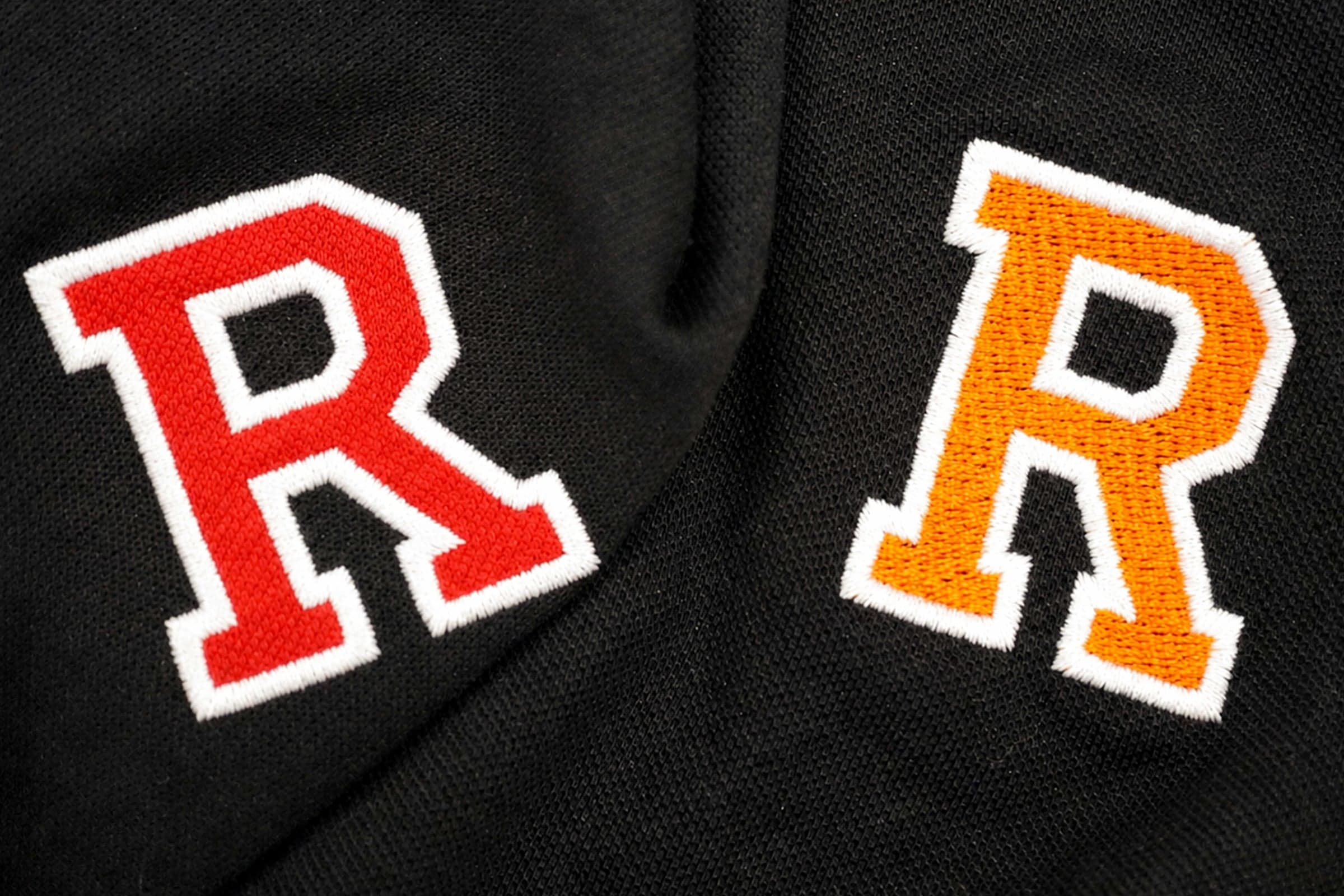
Crucially, a design on badge film must be digitized as one continuous, interlocking unit. There cannot be any separate, disconnected, or floating elements in the file. If the elements do not lock together properly, the finished badge simply will not hold its shape once it is removed from the machine. Scaling a garment file down and running it on badge film is one of the most common causes of disappointing badges — and one of the easiest to avoid.
The Harrow Reality Check: Theory vs. Production
To be completely honest, we used to just follow standard software guidelines for this process. But once we started embroidering and sampling these files ourselves in our Harrow studio, we realised textbook rules aren't always enough.
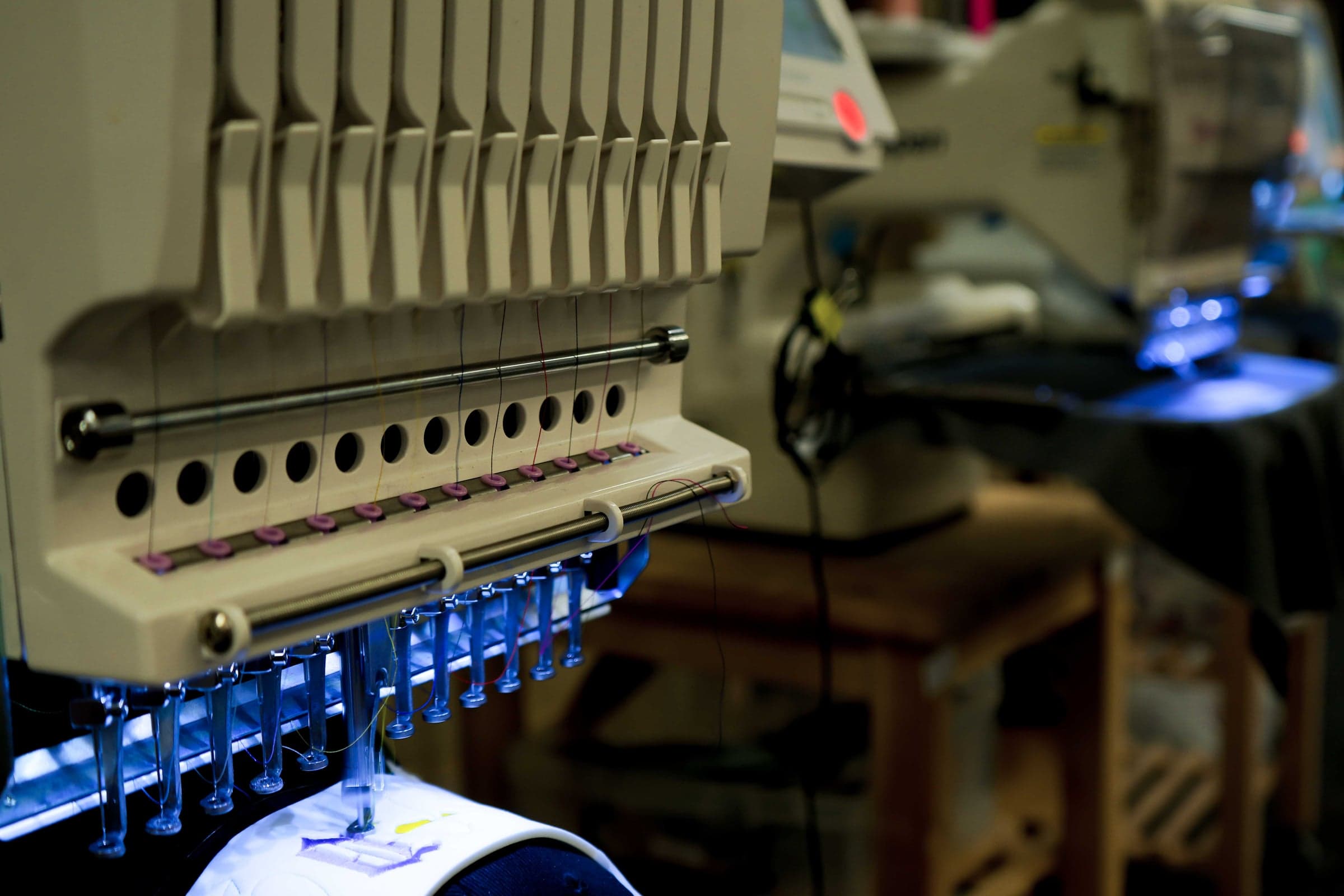
Creating this "thread fabric" requires a heavy, multi-directional cross-hatch underlay to anchor the design. We also know that a matching coloured bobbin for the final satin stitch is crucial, and that the heat-sensitive polyolefin film requires a post-stitch heat finish for a clean edge. We test all of this in-house so the technical "secret sauce" is baked into your file before you even hit start.
The Best of Both Worlds: Applique on E-Zee Badge Film
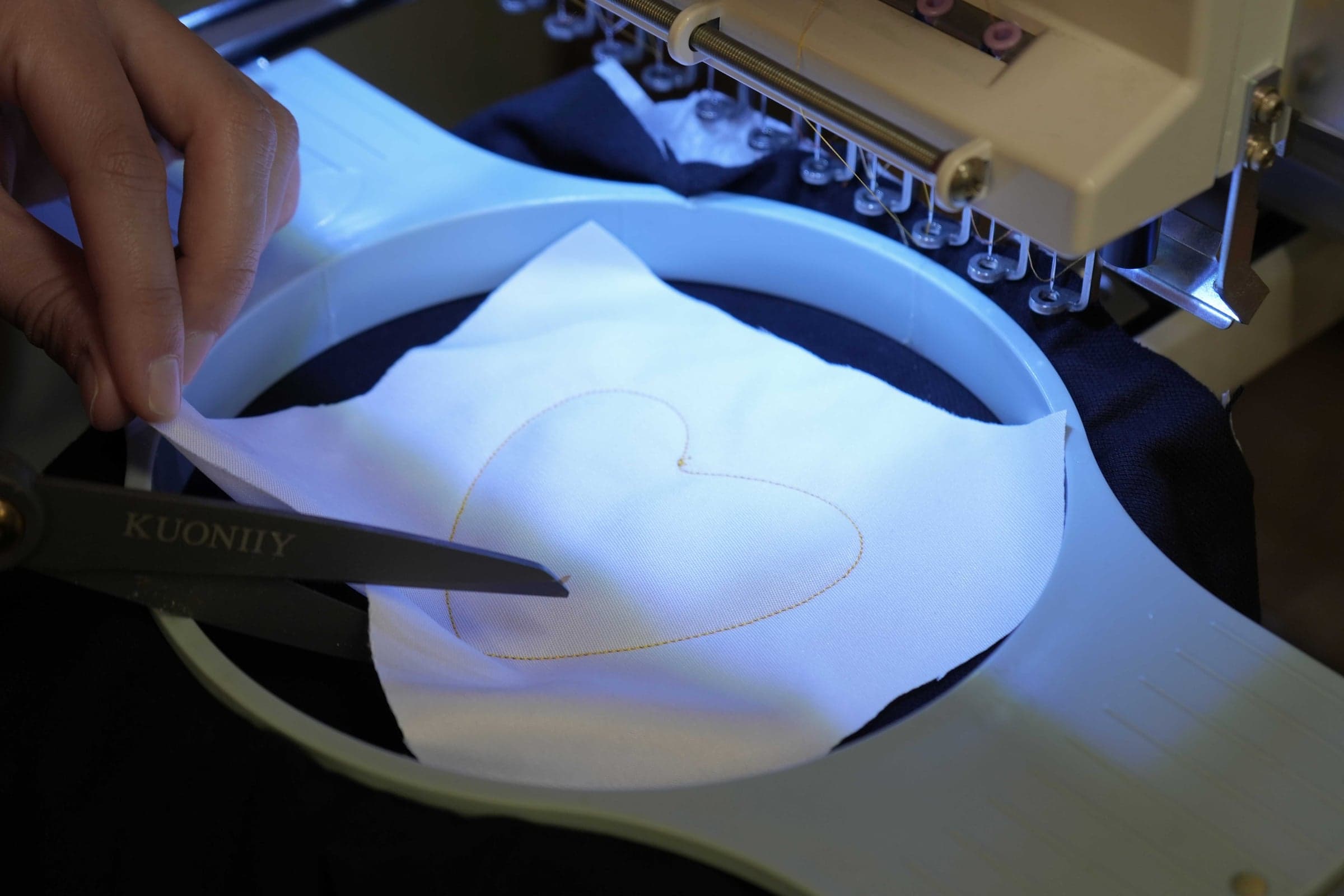
Want a solid fabric background without wasting thousands of stitches to build it? We offer a perfect hybrid: we supply precision laser-cut twill applique in core colours (black, white, navy, red) cut to the exact shape of your logo. You hoop the E-Zee Badge Film for easy handling, secure the pre-cut twill, and run the file. No laser cutter required, zero manual cutting, and massive stitch savings.
If a job is too small, too urgent, or simply not worth setting your machines up for, we can manufacture the finished badges instead through our specialist sister system, EmbroideryBadge.uk.
Setting Up Your Badge Order
✓Do
- ✓Tell us the finished badge size and shape: The border allowance and fill coverage are built around the exact finished dimensions, so measure the badge, not the artwork.
- ✓Tell us the border type: A stitched satin border and a laser-cut edge are set up differently in the file. If you are not sure which you need, say so and we will advise.
- ✓Send vector artwork where possible: AI, EPS, or PDF files help preserve clean lines at badge scale. A clear high-resolution image works too.
✕Don't
- ✕Scale a garment logo straight onto a badge: A left-chest file and a badge file are two different setups. Running one as the other usually shows.
- ✕Push text too small: Lettering below about 4.5mm for block fonts (6mm for serif or script) struggles to stay readable in thread, and a badge gives it nowhere to hide.
- ✕Assume one file covers both jobs: If you need the same logo on garments and on badges, tell us — if we digitized your original, a simple logo can often be adapted for a reduced edit charge rather than a full re-punch.
The Border Runs Last — For a Reason
In a properly sequenced badge file, the base and detail stitch first and the satin border runs last. On E-Zee Badge Film, this final satin stitch acts as a natural perforator, allowing the badge to easily pop out of the hoop. Get the sequence wrong, and the registration fails. Follow it with a quick heat press to melt away any residual plastic fringe, and you get a perfectly clean, commercial-grade border.
Not at all. While E-Zee Badge Film requires a highly specialized, thread-heavy setup, we regularly digitize for traditional badge bases like heavy twill, felt, and standard woven badge fabrics.
Yes. A twill or felt base provides its own structural integrity, meaning we don't need to build a heavy "thread fabric" background. Instead, we focus on proper pull compensation, density adjustments suited to the fabric's weave, and a border sequence that seals the cut fabric edge without fraying.
Usually it needs adapting rather than reusing as-is — badges call for their own densities and border sequence. If we digitized your original file, a simple logo can often be adapted for a reduced edit charge instead of a full re-punch. Send us the order ID and we will advise.
Most common shapes and sizes are no problem — circles, shields, rectangles, and custom shapes. Tell us the finished size and the border type when you order, and if anything about the design will not work at that size, we will flag it before digitizing rather than after.
We manufacture those too — embroidered, woven, printed, and more — through our sister system EmbroideryBadge.uk. It runs as a separate system with its own account and login, and the team can move your design straight into production.
Send Your Artwork. Get a Badge File That Runs.
Get a QuoteTell us the finished size, base material, and border type, and the team takes it from there. Or call us on 0800 368 7414
Questions first? Just ask in the chat — or call 0800 368 7414.